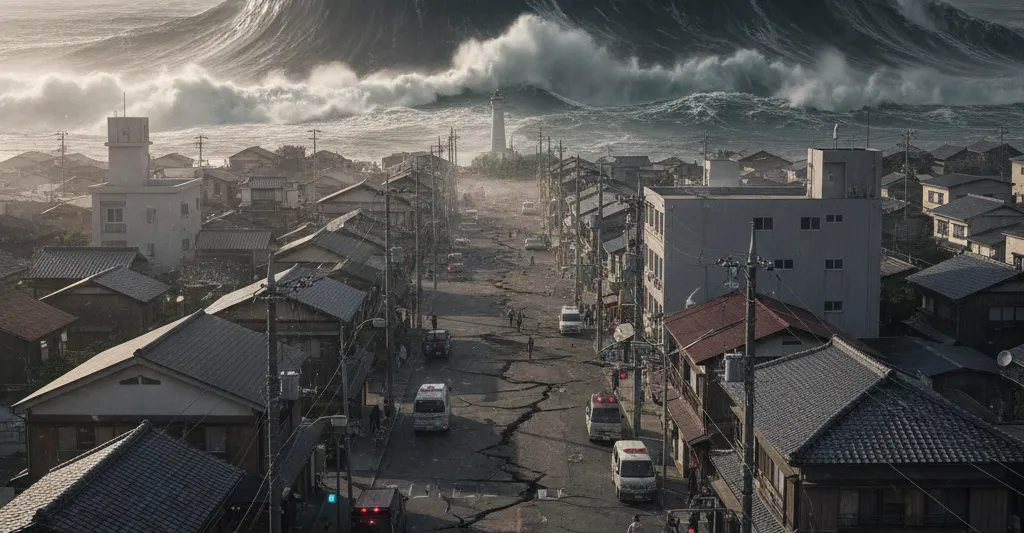
Japan was shaken late Monday after a powerful 7.6-magnitude earthquake struck off the country’s northeastern coast, prompting immediate tsunami warnings and triggering widespread concern across a region historically vulnerable to seismic disasters. The Japan Meteorological Agency (JMA) confirmed the quake occurred offshore, generating tsunami waves that reached roughly 50 centimeters in several coastal communities.
Authorities issued urgent evacuation advisories moments after the quake, warning that waves could rise as high as three metres in certain areas. While the waves observed so far have remained relatively small, officials urged residents to remain alert as aftershocks continue.
Initial Impact and Tsunami Warnings
According to early reports, the earthquake struck in the evening hours, strongly shaking cities across the Tohoku region—an area already etched into global memory due to the catastrophic 2011 earthquake and tsunami.
Within minutes of the tremors, the JMA issued a major tsunami warning, later updating it to a standard tsunami advisory after water levels stabilized at approximately 0.5 metres in affected areas such as Miyagi, Iwate, and Fukushima prefectures.
Television broadcasts across the nation displayed flashing red banners urging residents in coastal zones to “Evacuate Immediately.” Public transportation was temporarily halted in several cities, with bullet train services briefly suspended as a precaution.
Reassurance From Nuclear Regulators
One of the first concerns raised globally was the status of the Fukushima Daiichi Nuclear Power Plant, site of the 2011 meltdown following a 9.0-magnitude quake.
The International Atomic Energy Agency (IAEA) confirmed shortly afterward that no abnormalities were detected at the facility or surrounding nuclear sites. Japanese authorities also reported that all cooling systems remained operational and radiation levels were unchanged.
The quick assessment helped calm fears of another nuclear emergency, though plant operators said they would continue monitoring systems for several hours as aftershocks persist.
Japan’s High Seismic Vulnerability
Japan lies in the seismically volatile Ring of Fire, an area encircling the Pacific Ocean known for intense geological activity.
The nation experiences 1,500 earthquakes every year, with dozens strong enough to be felt. Advanced building codes, early warning systems, and tsunami detection networks have made Japan one of the world’s best-prepared countries for such disasters.
Despite this preparedness, large quakes—like the one on Monday—serve as reminders of the constant risk.
Historical Context: Echoes of the 2011 Megaquake
This latest tremor inevitably draws comparisons to the devastating March 11, 2011 Tōhoku Earthquake, a 9.0-magnitude event that triggered a massive tsunami, killing nearly 20,000 people and causing the worst nuclear accident since Chernobyl.
Although the current earthquake is significantly smaller, seismic experts emphasize that the same subduction zone along Japan’s Pacific coast remains active and capable of producing major aftershocks or larger events in the future.
Monday’s quake occurred in a similar offshore region, though not in the exact location of the 2011 rupture. Historically, earthquakes in this zone tend to come in sequences, triggering heightened monitoring by the JMA.
The Science Behind the Quake
Preliminary analysis indicates that the quake likely originated from subduction-related tectonic activity, where the Pacific Plate dives beneath the North American Plate. This area is known for producing large megathrust earthquakes.
Seismologists suggest that the 7.6 magnitude made this quake one of the strongest to hit Japan in recent years, though still within expected geological behavior for the region.
As is typical after a major offshore quake, experts warn that aftershocks could continue for days or even weeks, some possibly exceeding magnitude 6.
Government Response and Public Safety Measures
Japan’s emergency services, Self-Defense Forces, and local authorities quickly mobilized following the quake:
- Evacuation centers opened in several northern prefectures
- Coastal roads were closed temporarily
- Fishing communities were alerted to secure boats and equipment
- Schools and public buildings underwent structural checks
- Airports in the region conducted runway inspections
So far, no significant damage or casualties have been reported, but assessments are ongoing.
Communication and Media Coverage
Television and radio stations interrupted programming with urgent public-safety announcements, while mobile phones across the region buzzed with Japan’s automated Earthquake Early Warning System (EEW) — a technology credited with saving thousands of lives.
In major cities such as Sendai and Morioka, crowds gathered in public squares as aftershocks rattled the area. Social media platforms were flooded with videos showing shaking buildings, swaying streetlights, and emergency sirens.
International Reactions
Neighboring countries, including South Korea, China, and the Philippines, reported mild tremors but faced no tsunami threat. International monitoring agencies noted that the earthquake was unlikely to pose widespread risk beyond Japan.
World leaders and disaster-response organizations expressed solidarity, praising Japan’s swift emergency preparedness.
A Region Always on Alert
For residents of Japan’s northeast, Monday’s quake is a stark reminder of the region’s geological instability. While Japan remains one of the most disaster-ready nations in the world, the emotional trauma of 2011 still lingers.
Authorities continue to advise residents to:
- Stay away from coastal areas
- Avoid returning home until advisories are lifted
- Prepare emergency kits
- Expect aftershocks
As the night progresses, monitoring agencies will evaluate the seismic patterns to determine whether the quake was an isolated event or part of a larger tectonic shift.
Conclusion
Japan’s latest 7.6-magnitude earthquake demonstrates the nation’s ongoing battle with powerful natural forces beneath the Pacific Ocean. Although early reports indicate limited impact and no nuclear safety concerns, the incident underscores the need for constant vigilance in one of the world’s most earthquake-prone regions.
For now, life-saving early warnings, disciplined evacuations, and global-standard disaster preparedness once again highlight Japan’s resilience — even in the face of nature’s unpredictability.