You wake up in the morning, look out the window, and the world has disappeared behind a thick, grey-white curtain. The immediate reaction is to call it “weather.” Maybe it feels romantic; maybe it feels annoying because your commute just got harder.
But here is the reality: what you are looking at isn’t always just weather. Sometimes, it’s chemistry.
For years, we have used terms like Fog, Mist, and Smog interchangeably, assuming they are just different words for “low visibility.” They are not. One is a natural cloud; one is a category of visibility; and one is a toxic cocktail that can damage your lungs. Understanding the difference isn’t just about vocabulary—it is about knowing when it is safe to breathe.
This article breaks down the science, the seasonal triggers, and why your specific location dictates whether you are walking through water vapor or poison.
1. The Definitions: Breaking Down the Grey Wall
To understand what is happening outside, we first need to define the players. These aren’t just synonyms; they are distinct meteorological and chemical states.
Mist: The “Lite” Version
Mist is essentially a cloud that hasn’t quite formed yet. It consists of tiny water droplets suspended in the air.
- The Visibility Rule: This is the scientific dividing line. If you can see further than 1 kilometer (0.6 miles) but clarity is reduced, it is technically Mist.
- The Feel: Mist feels damp and cool but rarely feels oppressive. It usually occurs when warm, moist air meets sudden cooling, causing water vapor to condense rapidly. It is common in the early morning and evaporates quickly as the sun rises.
Fog: The Cloud on the Ground
Fog is exactly what it looks like: a cloud that has decided to touch the earth.
- The Visibility Rule: If visibility drops below 1 kilometer, Mist has officially graduated to Fog.
- The Composition: It is almost entirely pure water droplets.
- The Mechanism: Fog forms when the air temperature drops to the “dew point”—the temperature at which air can no longer hold all its water vapor, forcing it to condense into liquid droplets. This is why you often see it near rivers, lakes, or after heavy rain.
Smog: The Toxic Trap
This is where things get ugly. The word itself is a portmanteau coined in the early 20th century: Smoke + Fog = Smog.
- The Composition: Smog is not just water. It is a mixture of fog and pollutants—specifically Nitrogen Oxides (NOx), Sulfur Dioxide (SO2), Carbon Monoxide, and Particulate Matter (PM2.5).
- The Trap: In pure fog, the water droplets are clean. In smog, those water droplets latch onto dust, smoke, and chemical particles, creating a heavy, dirty suspension that hangs in the air.
2. The Science of Seasons: Why Winter?
You rarely see heavy fog or smog in July. These phenomena are strictly dictated by the mechanics of winter. To understand why, you have to understand a concept called Temperature Inversion.
The Normal Cycle (Summer/Spring)
Usually, the sun heats the ground. The ground warms the air right above it. Warm air is lighter than cold air, so it rises. As it rises, it carries pollutants (car exhaust, factory smoke, dust) up into the atmosphere, where wind disperses them. It is nature’s self-cleaning mechanism.
The Winter Trap (Temperature Inversion)
In winter, specifically during long nights, the ground loses heat rapidly and becomes very cold. The layer of air touching the ground also becomes freezing cold. However, a layer of warmer air sits right on top of it, acting like a lid.
Because cold air is heavy, it cannot rise. It gets trapped near the surface, pinned down by the warmer air above. This means every bit of smoke, dust, and emission released by cars and factories has nowhere to go. It just sits there, accumulating day after day.
When you add humidity (moisture) to this trap, the moisture condenses onto the pollutants. That is how a crisp winter morning turns into a suffocating smog event.
3. Regional Impact: Geography is Destiny
Not every region suffers equally. Your location determines whether you get natural Fog or industrial Smog.
The Fog Zones: Rural and Riverside Areas
If you live near major rivers, canals, or vast agricultural fields, you are in a Fog Zone.
- Why here? Plants release moisture through a process called transpiration. Rivers provide constant evaporation.
- The Result: When the temperature drops at night, this excess moisture condenses into thick, white fog. While visibility here can be zero (making driving deadly), the air itself is usually breathable. It is dense, wet, and smells like damp earth.
The Smog Belts: Urban and Industrial Basins
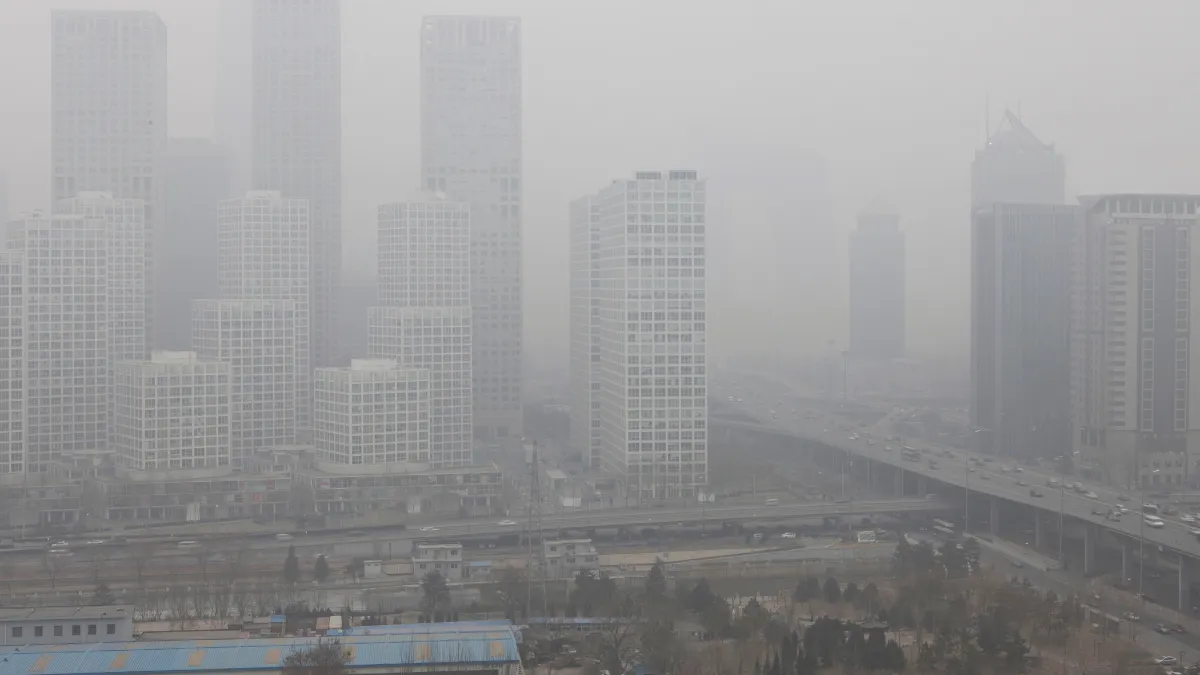
Cities like Lahore, Delhi, or Beijing suffer from Smog because they combine high emissions with bad geography.
- The “Bowl” Effect: Many of these cities sit in flat basins with low wind speeds during winter. There is no breeze to push the dirty air away.
- The Source: Millions of vehicles, construction dust, brick kilns, and industrial emissions pump particles into the air.
- The Conversion: When the rural fog drifts into the city, it mixes with these urban emissions. The white fog turns yellow or grey. The sun cannot burn it off because the particulate matter blocks the sunlight, preventing the ground from warming up. This creates a cycle where the smog sticks around for days or even weeks.
4. The Litmus Test: How to Tell the Difference
You don’t need a laboratory to know what is outside. You just need to observe closely.
- Check the Color:
- Fog: Pure white or milky.
- Smog: Yellowish, brownish, or dirty grey.
- The Smell Test:
- Fog: Neutral or smells like wet soil/rain.
- Smog: Acrid, metallic, or smells like burning rubber/exhaust.
- Physical Reaction:
- Fog: You might feel cold or damp.
- Smog: Your eyes sting or water. You may feel a “scratch” in your throat or an urge to cough. This is your body reacting to chemical irritation.
- Sunlight Interaction:
- Fog: Usually burns off by noon as the sun heats the ground.
- Smog: Often persists throughout the day, creating a permanent haze that dims the sun into a dull orange disc.
5. Why It Matters: The Health Reality
We need to stop treating Smog like “bad weather.” It is a health hazard.
- Fog risks are physical: The main danger is crashing your car due to low visibility. Health-wise, it might aggravate arthritis or asthma simply because of the cold, damp air, but it is not toxic.
- Smog risks are systemic: The particles in smog (PM2.5) are so small they don’t just sit in your lungs; they can enter your bloodstream. Prolonged exposure can lead to heart disease, strokes, and permanent lung damage.
The Bottom Line
Understanding the difference between Mist, Fog, and Smog is about survival and adaptation. If it is Fog, drive slowly and use your fog lights. If it is Smog, the best move is to stay indoors, seal the windows, and wear a mask rated for particulate matter (like an N95) if you must go out.
Don’t rely on your eyes alone. Before you plan your day, check the Air Quality Index (AQI) on your phone. If the numbers are high, that grey cloud outside isn’t nature—it’s pollution.