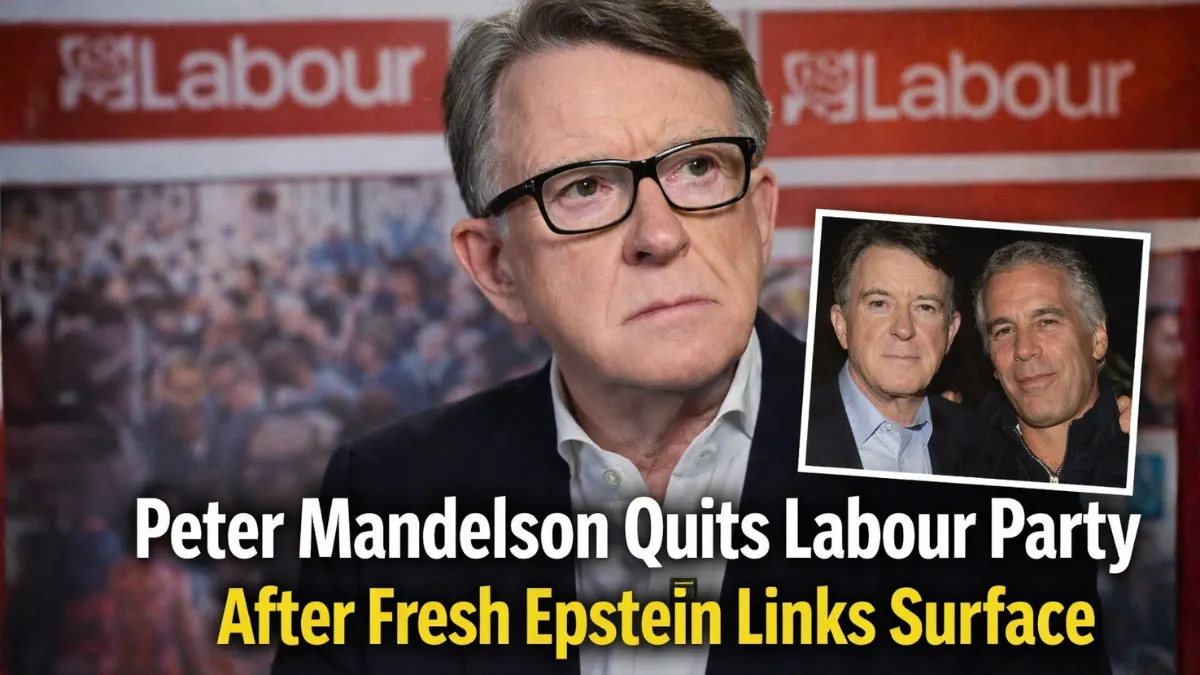
Former British cabinet minister Peter Mandelson has resigned from Prime Minister Keir Starmer’s Labour Party, following renewed media reports detailing his past connections to disgraced U.S. financier Jeffrey Epstein, according to reports published on Sunday.
The resignation marks the latest chapter in a long-running controversy that has repeatedly resurfaced around one of Labour’s most influential political figures, and comes amid heightened public scrutiny following the release of new Epstein-related documents in the United States.
Renewed Scrutiny Forces Exit
Mandelson, a senior architect of New Labour during the governments of Tony Blair, said he chose to step down to avoid becoming a distraction for the party at a politically sensitive moment.
In a statement cited by British media, Mandelson said he did not want to cause “further embarrassment” to Labour as questions once again emerged about the nature and extent of his past contact with Epstein [1].
While Mandelson has previously acknowledged knowing Epstein socially, he has consistently denied any involvement in or knowledge of Epstein’s criminal activities.
Fresh Epstein Files Reignite Political Pressure
The latest controversy follows the release of newly unsealed U.S. court documents linked to investigations into Epstein’s financial and social network. Although the documents do not accuse Mandelson of criminal wrongdoing, they renewed public and political focus on figures who maintained contact with Epstein prior to his arrest and death in 2019.
Opposition politicians and some Labour critics argued that Mandelson’s continued association with the party risked undermining Labour’s efforts to present itself as a government committed to integrity and accountability.
A History of Influence, and Controversy
Mandelson, often described as one of the most powerful strategists in modern British politics, served in multiple senior roles, including Business Secretary and European Commissioner, and was a close ally of both Tony Blair and Gordon Brown.
However, his career has also been punctuated by controversy. In recent years, his reputation has been repeatedly tested by questions surrounding his relationship with Epstein, a convicted sex offender whose extensive network of high-profile contacts has continued to send shockwaves through political and financial elites on both sides of the Atlantic.
Mandelson was previously forced to step aside from public roles after earlier revelations about Epstein, making his latest resignation a culmination rather than a sudden rupture.
Labour Party Seeks to Contain Fallout
For Prime Minister Keir Starmer, Mandelson’s departure removes a politically awkward issue as Labour seeks to consolidate authority and maintain public trust.
Starmer has made restoring ethical standards in public life a central theme of his leadership, frequently contrasting Labour’s approach with scandals that plagued previous governments. Mandelson’s resignation may help the party draw a line under the episode, though questions are likely to persist.
Labour officials have so far declined to comment in detail, emphasizing instead the party’s focus on governance and policy priorities.
No Criminal Allegations, But Lasting Reputational Damage
Crucially, Mandelson is not accused of any criminal wrongdoing, and no legal action has been taken against him in relation to Epstein. However, analysts note that in today’s political climate, reputational risk alone can be sufficient to end public roles.
The Epstein case has repeatedly demonstrated how associations, even indirect or historical, can carry significant political consequences, particularly as more documents continue to emerge.
Five Load-Bearing Claims
- Peter Mandelson resigned from the Labour Party following renewed Epstein-related media reports [1].
- The controversy was reignited by newly released U.S. court documents linked to Epstein