“I’ve used ChatGPT every day for three years. Just spent two hours on Gemini 3. I’m not going back,” says Google CEO Sundar Pichai
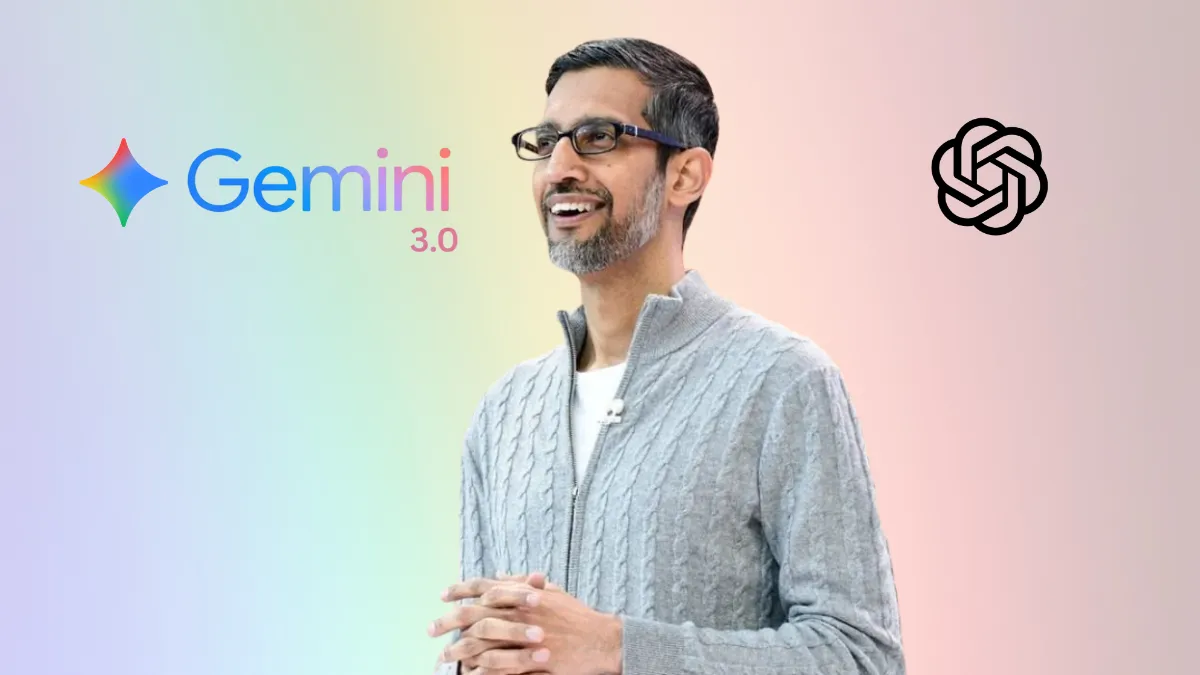
Google CEO Sundar Pichai has delivered one of the strongest endorsements yet of his company’s latest artificial intelligence push, saying he has stopped using ChatGPT after spending extended time with Gemini 3, Google’s newest flagship AI model.
“I’ve used ChatGPT every day for three years,” Pichai said. “I just spent two hours on Gemini 3. I’m not going back.”
The comment, shared during internal discussions and echoed in industry circles, underscores Google’s growing confidence that Gemini 3 represents a turning point in the increasingly competitive AI race dominated by OpenAI, Microsoft, and emerging rivals.

A shift in tone from Google’s CEO
Pichai has historically been measured when discussing competitors, often emphasizing the broader progress of AI rather than direct comparisons. His remarks signal a notable shift, suggesting Google now believes it has closed, or surpassed, the gap with OpenAI’s ChatGPT in real-world usage.
According to people familiar with Gemini 3, the model reflects a deeper integration of reasoning, multimodal understanding, and long-context memory — areas where Google has invested heavily over the past year. Internally, executives have framed Gemini 3 as less of an experimental model and more of a “daily cognitive tool” designed for sustained professional use.

Why Gemini 3 matters
Gemini 3 is positioned as Google’s most capable AI system to date, building on earlier versions that struggled to match ChatGPT’s momentum. Engineers describe the new model as faster, more precise, and better at complex problem-solving across text, code, images, and data analysis.
For Google, the stakes are high. The company’s core businesses — search, advertising, and productivity software — are directly threatened by AI systems that change how people access information. Gemini is central to Google’s strategy to reassert leadership rather than play defense.
Pichai’s personal endorsement is likely intended to send a message both inside and outside the company: Google is no longer chasing, but setting direction.
The broader AI rivalry
ChatGPT remains the most widely recognized consumer AI product, and OpenAI continues to move aggressively with new models and enterprise partnerships. However, the competition is increasingly defined by depth of integration rather than novelty.
Google’s advantage lies in its ecosystem. Gemini is being embedded across Search, Gmail, Docs, Android, and developer tools, positioning it not as a standalone chatbot but as an ambient layer across everyday computing.
Industry analysts note that if Gemini 3 consistently delivers on its technical promises, switching costs could begin to favor Google — especially for users already entrenched in its services.
What this signals for the AI market
Pichai’s statement is less about abandoning ChatGPT and more about signaling confidence. In the AI race, perception matters almost as much as benchmarks. A CEO publicly declaring a preference shift suggests internal conviction that the technology is ready for prime time.
Whether Gemini 3 truly changes user behavior at scale will become clear in the coming months. But the message from Google’s top executive is unmistakable: the company believes it has built an AI good enough that even its biggest skeptics — including himself — no longer need to look elsewhere.
For an industry moving at breakneck speed, that confidence alone marks a meaningful moment.