
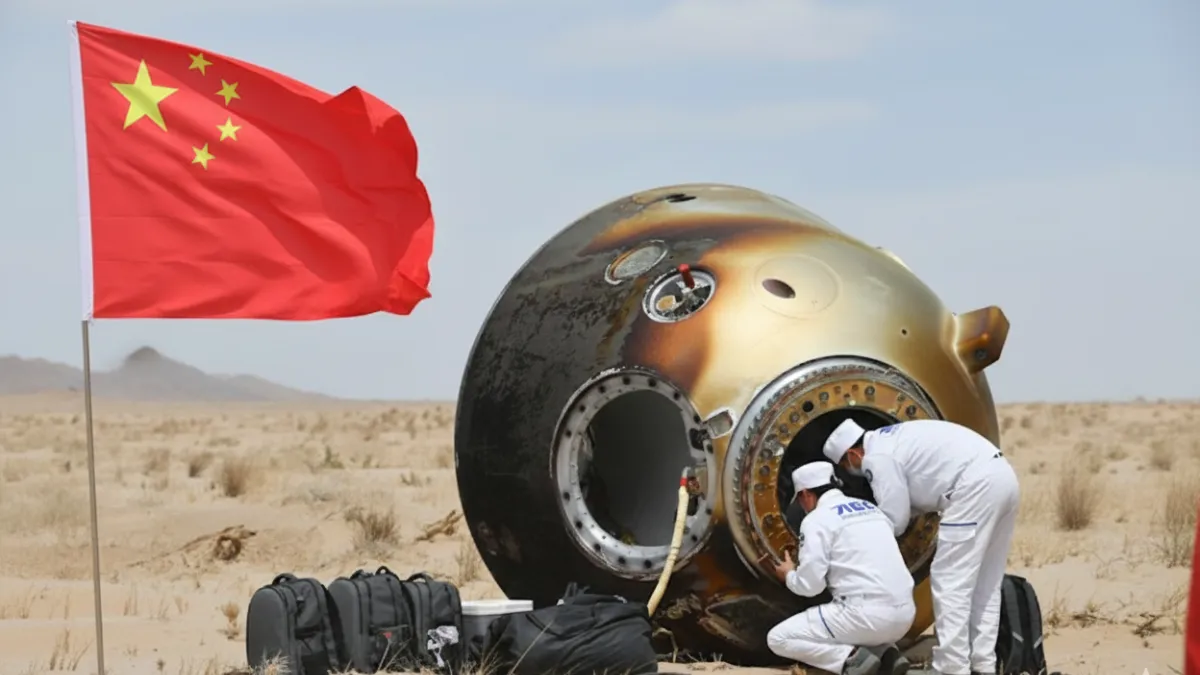
On November 25, 2025, China carried out an extraordinary emergency space operation, launching an uncrewed Shenzhou-22 spacecraft to address a potentially life-threatening situation aboard its Tiangong space station. The decision came after space debris damaged the Shenzhou-20 capsule previously docked there, rendering it unsafe for astronaut return.
The mission lifted off from the Jiuquan Satellite Launch Center in northwest China atop a Long March-2F rocket, as shown in live coverage by China’s state broadcaster CCTV. After a textbook ascent, Shenzhou-22 successfully entered its target orbit and made its way toward Tiangong.
A High-Stakes Rescue Story
The drama began earlier this month, when micro-cracks were discovered in the return module of the Shenzhou-20 spacecraft, which had been docked to Tiangong. Chinese authorities determined these cracks likely resulted from an impact with tiny orbital debris — damage that could jeopardize the safety of any reentry attempt.
Originally scheduled to return to Earth on November 5, the Shenzhou-20 crew’s departure was abruptly postponed. In an unexpected but swift maneuver, China reassigned the Shenzhou-21 capsule — fresh from delivering a new crew — to ferry the earlier Shenzhou-20 astronauts back safely. That move, however, left the three newly arrived crew on board Tiangong without a guaranteed escape vehicle, a risk that China could not ignore.
Why This Mission Matters
Shenzhou-22 was not part of the original plan — it was initially slated for a crewed mission in 2026. But with the safety of astronauts now on the line, and no other reliable return craft available, China accelerated the launch.
Officials from the China Manned Space Agency (CMSA) say the capsule will remain docked to Tiangong until around April 2026, when it will serve as the return vehicle for the current crew of the Shenzhou-21 mission.
According to CMSA, from identifying the problem to launching the mission took just 16 days — a speed rarely seen in human spaceflight.
This rapid response reflects both China’s growing ambition in space and its commitment to crew safety. It also highlights a sobering truth: space debris is an ever-present danger, even for well-prepared and advanced space programs.
The Bigger Picture
- The three astronauts aboard Tiangong — Zhang Lu, Wu Fei, and Zhang Hongzhang — are reportedly safe and “working normally.”
- China’s space program has emphasized contingency planning, keeping backup rockets and capsules in a near-constant state of readiness.
- Analysts note that this incident may accelerate global conversations around formalized space-rescue infrastructure, as more nations pursue long-term human presence in orbit. Space
For Beijing, the successful launch and docking of the Shenzhou-22 capsule is more than a technical achievement — it’s a demonstration of the country’s increased maturity in space operations, and its willingness to act quickly when astronaut lives are at stake.