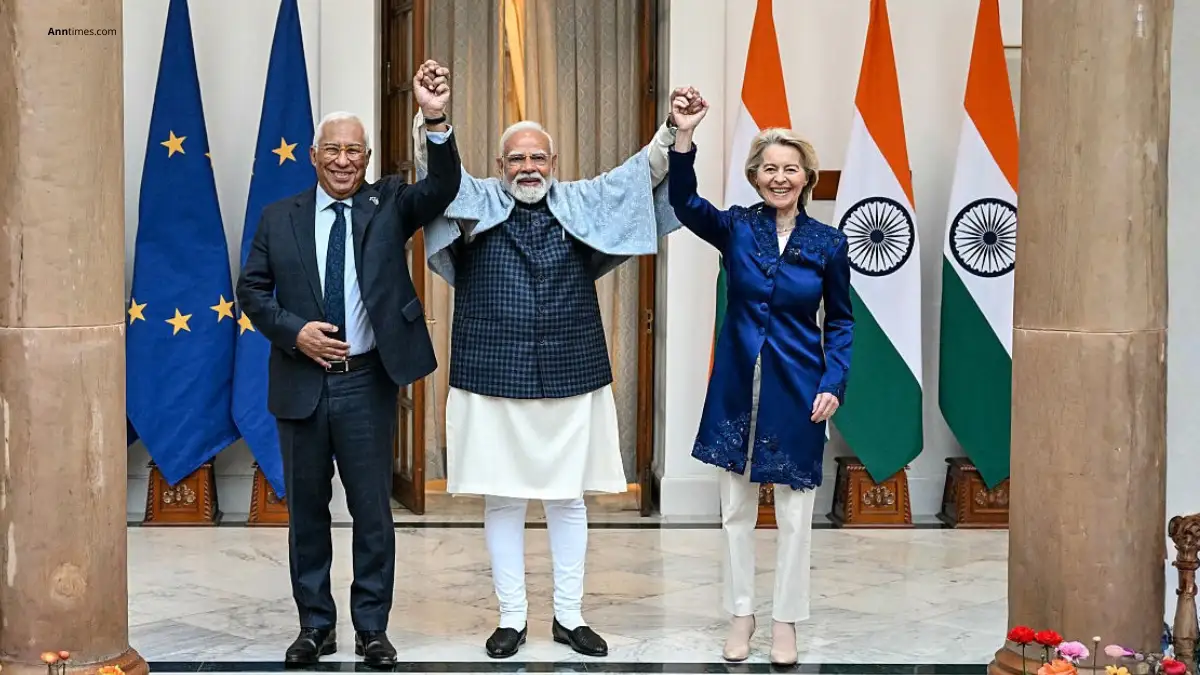
Indian Prime Minister Narendra Modi on Tuesday announced the finalisation of a landmark free trade agreement between India and the European Union, bringing to a close negotiations that have stretched over nearly two decades and marking one of the most significant trade breakthroughs in India’s modern economic history.
Speaking after the agreement was concluded, Modi described the pact as “the mother of all deals,” saying it would unlock major economic opportunities for billions of people and deepen ties between two of the world’s largest markets. The agreement covers trade in goods and services, investment protections and cooperation across key industries, according to officials familiar with the negotiations.
The India–EU free trade talks were first launched in 2007 but repeatedly stalled over disputes involving tariffs, market access, labour standards and environmental rules. Progress accelerated in recent years as both sides sought to diversify supply chains, reduce strategic dependencies and strengthen economic resilience amid global geopolitical uncertainty.
European officials said the deal would give EU companies improved access to one of the world’s fastest-growing major economies, while Indian exporters would benefit from reduced tariffs and smoother regulatory pathways into the EU’s single market of more than 440 million consumers. The EU is already one of India’s largest trading partners, with bilateral trade worth more than €120 billion annually.
For India, the agreement aligns with Modi’s broader push to position the country as a global manufacturing and export hub, attracting investment while integrating more deeply into global value chains. Sectors expected to benefit include manufacturing, pharmaceuticals, technology, renewable energy and services.
While the broad outlines of the deal have been finalised, officials said technical ratification processes remain on both sides, including approval by EU member states and the European Parliament. Detailed legal texts are expected to be published in the coming months.
Economists say the agreement could reshape trade flows between India and Europe and serve as a template for future trade deals involving emerging and advanced economies, especially at a time when global trade rules face increasing strain.