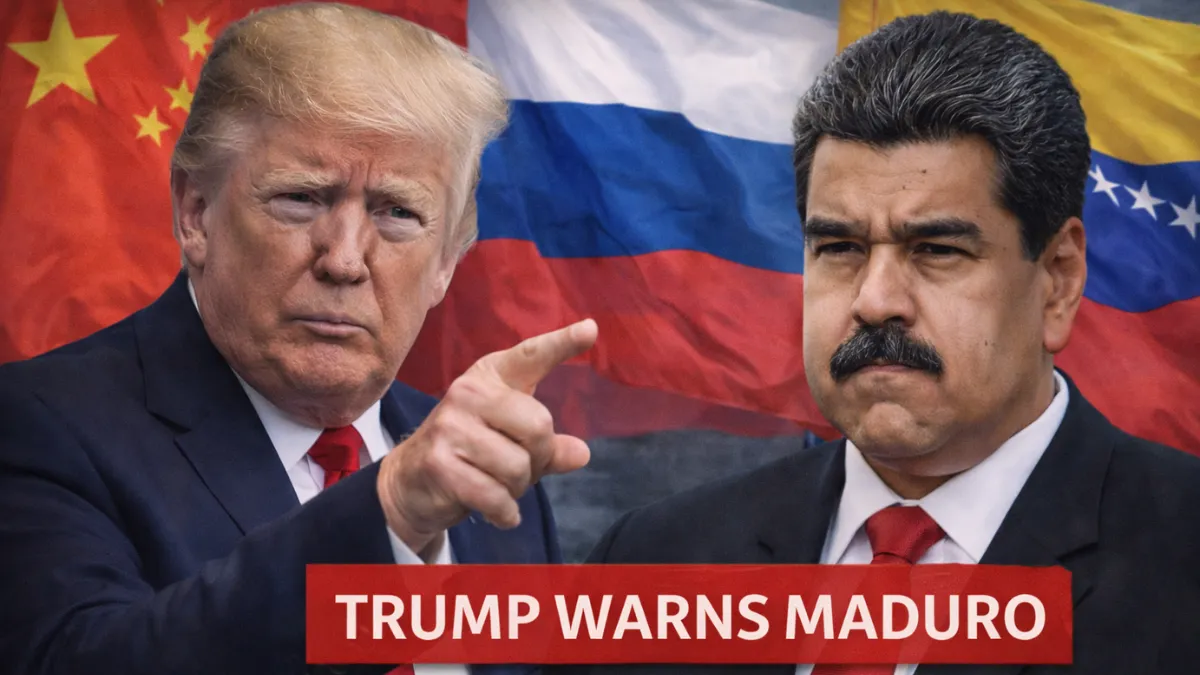
President Donald Trump on Monday delivered a stark warning to Venezuelan President Nicolás Maduro, saying if Maduro chooses to “play tough” amid intensifying U.S. pressure, it could be the last time he does so, as China and Russia publicly back Caracas in a high-stakes geopolitical standoff.
U.S. pressure campaign and Trump’s warning
From his Mar-a-Lago club in Florida, Trump doubled down on an escalating U.S. campaign designed to squeeze the Maduro government. The effort includes stepped-up actions by the U.S. Coast Guard and Navy to intercept and seize oil tankers in the Caribbean that the administration says are part of a “shadow fleet” evading sanctions on Venezuelan crude. Trump also suggested it would be “smart” for Maduro to step down.
In remarks that drew sharp international attention, Trump said that if Maduro continued to resist Washington’s approach, it could mark a turning point in U.S.–Venezuela relations. His comments come against a backdrop of a broader Caribbean naval presence and repeated pressure on Venezuela’s oil sector.
China and Russia’s responses
Beijing has strongly condemned recent U.S. actions in the region. China’s Foreign Ministry labeled the U.S. seizure of an oil tanker bound for China as a “serious violation of international law” and emphasized Venezuela’s right to pursue global economic partnerships.
Moscow, a longstanding ally of Caracas, echoed support for Maduro’s government. Russian officials have pledged “full support” and warned Washington against escalatory measures, even as Russian diplomats reportedly coordinate with Venezuelan counterparts to manage growing tension.
Venezuela’s position and broader context
In Caracas, Maduro’s government and its supporters denounced U.S. actions as unlawful and tantamount to piracy. Venezuelan officials have requested a United Nations Security Council session to address the blockade and its implications for global oil markets.
The standoff is unfolding amid broader strategic competition in the Caribbean and Latin America, where U.S. efforts to curb narcotics trafficking and enforce sanctions intersect with geopolitical rivalry involving Russia and China.
Why matters
The confrontation highlights how U.S. foreign policy under Trump has shifted toward aggressive application of economic and maritime pressure to confront governments Washington deems hostile or destabilizing. The public backing of Venezuela by China and Russia underscores rising geopolitical friction that could have implications for energy markets, regional stability, and international law.