Lede
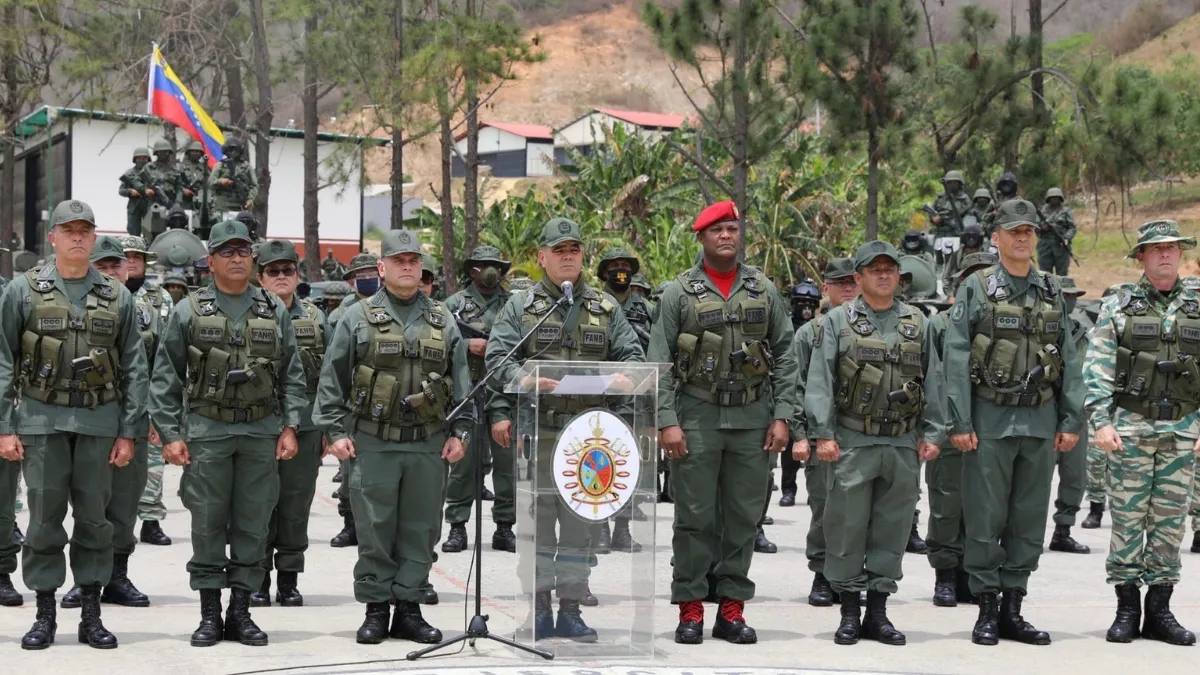
As Venezuela grapples with unprecedented political upheaval following the U.S. capture of President Nicolás Maduro, one institution above all others will determine its future: the Venezuelan military. The armed forces’ loyalties, internal privileges, and vested interests make it the central power broker in a country teetering between fragmentation and transition.
A military intertwined with the state
The Venezuelan military has not been a neutral, professional institution separate from politics. Under Hugo Chávez and later Maduro, the armed forces were integrated deeply into governance, economic control, and national security policy. Institutional reforms and patronage networks gave the military a stake in maintaining the status quo rather than serving as an apolitical guarantor of national sovereignty.
Civil-military scholars note that constitutional and doctrinal changes since the late 1990s increased military involvement in political and economic spheres while weakening independent civilian oversight. Officers were placed in key ministries and state corporations, including oil, mining, and customs, blurring the institution’s role as a defender of the state with that of a political actor.
Loyalty bought with power and privilege
Venezuela’s military increasingly became a pillar of the Chavista power structure by trading loyalty for money, rank, and influence. Oil-derived funds were channelled to military budgets, often bypassing transparent budget processes. Defense leaders controlled lucrative sectors like ports, food distribution, and key industries, entrenching their economic as well as political power.
This created a system in which military leaders personally benefited from maintaining the regime. In practice, this meant that breaking with Maduro or his political inheritance would not simply be a matter of ideology — it would represent a threat to entrenched economic interests.
The military’s role in the recent transition
Even as Maduro was captured and interim leadership under Vice President Delcy Rodríguez asserted control, the military’s position remained pivotal. Analysts from Al Jazeera argue that any leader — whether Rodriguez, opposition figures, or future negotiators — must secure the military’s cooperation to govern effectively.
Without a cohesive shift in military support toward a new political consensus, attempts at democratic transition or opposition rule are unlikely to succeed. The armed forces remain the only organized coercive power with the ability to enforce order nationwide.
Internal divisions and criminal entanglements
While the military remains institutionally loyal to Maduro and his successors, internal fractures and informal power networks complicate the picture. Recent reporting highlights how sectors of the military and allied actors — including paramilitary groups like colectivos and criminal syndicates in rural regions — exercise real power, making the overall security landscape fractious.
This fragmentation creates both risks and leverage. On one hand, a lack of unified leadership within the armed forces could lead to localised conflict or opportunistic behaviour by factions. On the other hand, it may provide openings for negotiated transitions that divide hardliners from pragmatists willing to back a broader political settlement.
Opposition attempts and the limits of civilian influence
Historically, opposition movements in Venezuela have recognised that civilian legitimacy — even strong electoral support — cannot succeed without shifting military alignment. During previous attempts to challenge Chavista rule, efforts to court military defectors were central to strategy. But the entrenched patronage system means that offers of amnesty or transition often face resistance absent credible guarantees that individual officers’ privileges will be protected.
This creates a classic dilemma in civil-military relations: to secure broader political transition, leaders must either offer protections that undermine accountability or risk alienating the very institution needed to keep peace.
External pressures and geopolitical variables
International intervention — whether from the United States, as seen in recent military operations, or from Russia and China, which have historically backed the Maduro government — interacts with internal military dynamics. The armed forces’ perception of foreign threats and opportunities shapes whether they will rally around nationalistic narratives or consider alignment with new political projects.
The military’s strategic calculus is not simply about who holds office, but who controls the state apparatus and the economic levers that sustain elite privileges. In this sense, external actors can influence but not dictate outcomes without buy-in from the armed forces.
Why the military remains central to Venezuela’s future
The Venezuelan military is not merely a security institution; it is a political and economic powerhouse whose decisions will determine whether the country slides toward instability or begins a fragile process of reconstruction. The capture of Maduro has exposed that the regime’s continuity does not depend on a single individual, but on whether the armed forces — as an institution — will continue to protect an inherited power structure or pivot to new alignments.
As long as the armed forces retain control over coercive capabilities and economic privileges, their role will be decisive in:
• Maintaining order in a fragmented political environment;
• Defining the terms of any transition, including whether power is shared or contested;
• Shaping the economic direction through control of key sectors;
• Determining the level of engagement with foreign governments and investors.
The road ahead is uncertain — but military alignment will be decisive
Venezuela’s future will not be decided by any one speech, treaty, or electoral declaration. It will be decided by how the military balances its institutional interests against broader national aspirations for stability, democracy, and economic recovery.
Any credible pathway toward peace or democratic transition must engage with the armed forces’ internal incentives, fragmentations, and vested advantages — or risk collapse into deeper crisis.
The military, for now, remains the central arbiter of Venezuelan power.